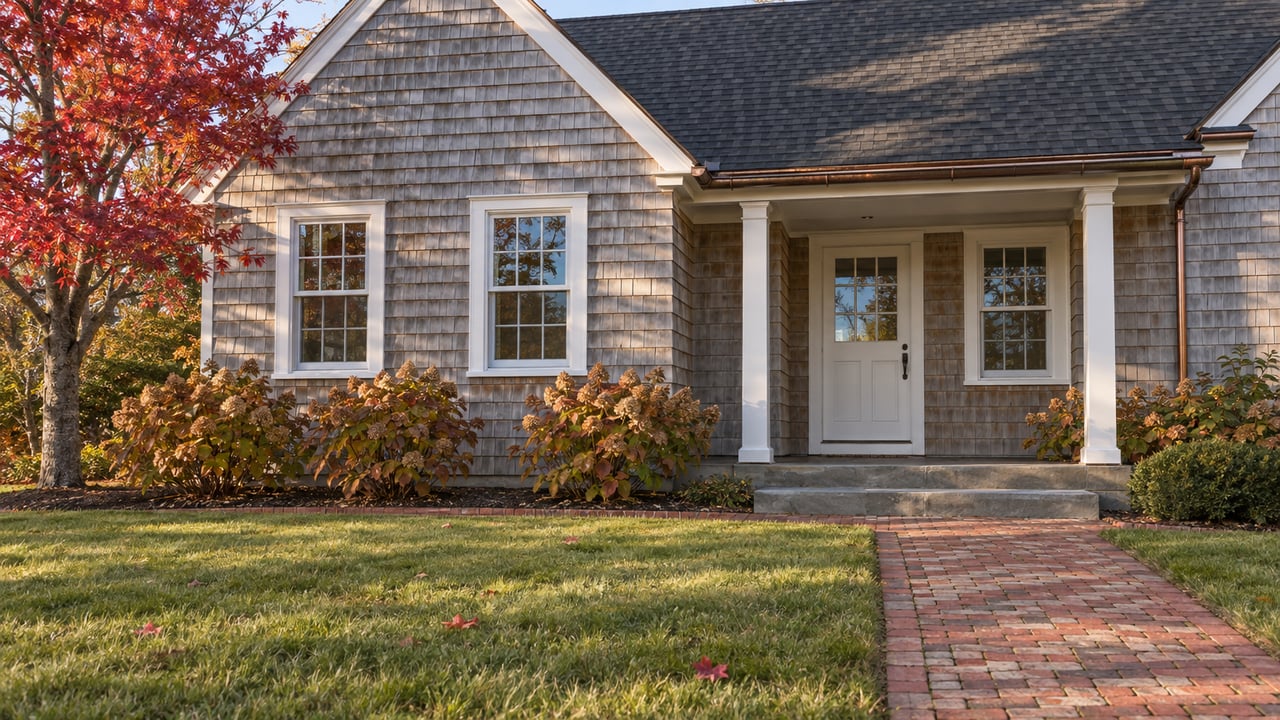
Take two Eastport houses that each sell for $750,000. They share the 11941 ZIP code and the same fire district. On one, the buyer pays nothing in Peconic Bay transfer tax. On the other, the buyer brings about $8,750 more to closing. The price is the same and so is the hamlet name, so the gap comes from neither. It comes from which town the parcel falls in.
Eastport sits in two towns, Brookhaven and Southampton, and only Southampton charges the Community Preservation Fund transfer tax. A listing gives the address, the bedroom count and the price. It rarely says which town's rules the deed will be recorded under. For an Eastport buyer, that answer can move closing costs by thousands of dollars, and near $2 million it moves them by tens of thousands.
A dam from 1772 still sets the bill
The split goes back further than most of the houses here. In 1772, Col. Josiah Smith and his brother-in-law David Howell of Moriches built a dam that now carries Montauk Highway. It formed the West Pond in Eastport, and according to the Town of Southampton's historical profile of Eastport, Speonk-Remsenburg and Westhampton, "that pond and stream were the dividing line for the townships of Brookhaven and Southampton." Back then the Brookhaven side was called Seatuck and the Southampton side was called Speonk. The two settlements took the shared name Eastport in 1860, after the postal department turned down "Seatuck" because it was too close to Setauket.
The name brought the two sides together. The town line still runs between them. The Suffolk County Clerk's town and district code table gives most hamlets one code. Eastport gets two: 0200 for Brookhaven and 0900 for Southampton. The Eastport Fire District uses an Eastport, NY 11941 address and lists itself as serving both the Town of Brookhaven and the Town of Southampton.
The town's own history admits the edges are unclear. Where Eastport, Speonk and Remsenburg meet, it says, "the actual lines are nondescript," depending on whether you go by school district, postal, railroad or property lines. A hamlet name won't tell you which town a house is in. The parcel's tax map district code will.
What the Southampton side adds at closing
On the Southampton side, a buyer owes what the town calls the CPF tax. The Town of Southampton's FAQ describes it as a 2.5% transfer tax on real property in the town: the 2% Peconic Bay Region Community Preservation Fund tax plus a 0.5% Peconic Bay Community Housing Fund tax. The first $400,000 of an improved residential parcel is exempt, and so is the first $100,000 of vacant, unimproved residential land, but only when the price is $2,000,000 or less. The tax is usually paid at closing. The title closer collects it and files it with the deed at the Suffolk County Clerk's Office. Under Tax Law §1449-dd, the grantee pays, which in a typical sale means the buyer.
The Brookhaven side has no equivalent. New York Tax Law §1449-aa defines the Peconic Bay Region as five towns: East Hampton, Riverhead, Shelter Island, Southampton and Southold. Brookhaven isn't one of them, and §1449-bb allows the 2% and 0.5% taxes only in towns inside that region.
Here is how the town's published formula works out at a few prices. Countywide, OneKey MLS reports a Suffolk County single-family median sale price of $750,000 for Q3 2026, up 5.6% from a year earlier, using data through October 7, 2026. That makes it a fair starting row.
| Purchase price, improved residential | Taxable amount, Southampton side | Peconic Bay taxes at 2.5%, Southampton side | Peconic Bay taxes, Brookhaven side |
|---|---|---|---|
| $750,000 | $350,000 | $8,750 | $0 |
| $1,200,000 | $800,000 | $20,000 | $0 |
| $1,900,000 | $1,500,000 | $37,500 | $0 |
| $2,000,000 | $1,600,000 | $40,000 | $0 |
| $2,050,000 | $2,050,000 | $51,250 | $0 |
These are only the Peconic Bay taxes. Every Eastport closing has other costs on both sides of the line, and this table leaves them out.
The $2 million edge
The bottom two rows show the oddest part of the rule. The $400,000 exemption doesn't shrink gradually as prices rise. It disappears. Section 1449-ee of the state Tax Law sets the $400,000 and $100,000 exemptions for East Hampton, Shelter Island and Southampton and says they "shall only apply to conveyances for residential property where the consideration is two million dollars or less."
So at exactly $2,000,000, a Southampton-side buyer pays tax on $1.6 million. One dollar more and the whole price is taxable, which adds about $10,000 to the bill. Going from $2,000,000 to $2,050,000 raises the price by $50,000 but raises the buyer's total outlay by about $61,250.
Eastport sales reach that range. 27east's Deeds & Transfers column for October 2, 2026 lists an Eastport sale at $1,900,000 that closed September 14. The column sorts sales by hamlet, not by town. If a sale at that price is on the Southampton side, the table shows the buyer pays $37,500 in Peconic Bay taxes. A Brookhaven-side sale at the same price pays none.
Nearby sales in the same column show where the Southampton-side numbers tend to fall: a Speonk sale at $880,000, and two Remsenburg sales at $975,000 and $1,700,000. All of those fall under the cap, where the exemption still applies. For Eastport sellers whose homes could be priced on either side of $2 million, the difference between $1,995,000 and $2,010,000 is about $10,000 of buyer cost on top of the $15,000 gap in price.
Why the tax is not going anywhere
The money stays local. According to the Town of Southampton's August 2026 preliminary official statement, the CPF brought in $100,781,504 in 2025 and held a balance of $219,006,172 as of December 31, 2025. The separate Community Housing Fund had $31,097,552. Voters added the 0.5% housing surcharge in a November 8, 2022 referendum, the same vote that raised the residential exemption from $250,000 to $400,000. State law extends the CPF tax through December 31, 2050.
The fund's work shows up close to Eastport. The town's 2026 spring/summer newsletter reports that CPF staff installed two new osprey nesting poles at the Conscience Point Marina property and are working on permits for more. One of the planned sites is 20 Bayview Road in Remsenburg/Speonk, where an osprey pole came down in heavy winter storms. With the tax authorized until 2050, it isn't a temporary charge. It's a lasting cost of owning on the Southampton side of the old West Pond line, and buyers there pay it at every resale.
Checking a parcel before the offer
Since the hamlet name won't settle it, here is where the answer comes from:
- Get the parcel's District/Section/Block/Lot number. Suffolk County's Real Property Tax Service Agency maintains the official tax map, and every parcel has this four-part number. District 0200 is Brookhaven.
- Look the address up on the county map. The county's tax parcel data page links to a viewer you can search by address or parcel number, and to the Real Property Tax Map Viewer, which is the official county tax map.
- Compare the district code with the Clerk's table, where 0900 means Southampton.
- If it's 0900, work out the tax at your offer price using the town's FAQ and see where you stand relative to $2 million.
The Southampton side also offers a first-time homebuyer exemption for a primary residence. It has a price ceiling and an income limit, both tied to State of New York Mortgage Agency limits on the contract date, and the statute and the town's FAQ explain who qualifies.
A few quick questions
Does the 0.5% housing tax get the same exemption? The Town of Southampton's FAQ applies the $400,000 and $100,000 exemptions, and the $2 million cap, to the combined 2.5% charge.
Who pays, the buyer or the seller? Section 1449-dd puts it on the grantee, usually the buyer. The same section shifts the duty to the grantor, the seller, when the grantee is exempt from the tax, and it makes both parties jointly liable if the grantee fails to pay. According to the town's FAQ, the title closer collects it at closing and files it with the deed.
Does vacant land work differently? Yes. For vacant, unimproved residential land the exemption is $100,000, and the same $2 million cap applies.
This is general information, not legal, tax or financial advice. Before you rely on any of these numbers, confirm your own transaction with your attorney or title closer.
If you're looking at Eastport, the first thing to pin down on any listing is which side of the line it's on, and running that math together before you write an offer is part of how I work. Samantha Bisagni is glad to look up the parcel with you and run the numbers at your price. Let's Connect.